By Michelle Skura, Esq., Lead Sex Crimes Lawyer | VS Criminal Defense Attorneys
In Maricopa County and throughout Arizona, one of the most common questions we hear from new clients is:
“How can I be charged with a felony sex crime involving a minor if there was no real minor involved?”
On its face, this may seem like a valid legal argument. If no actual child was ever part of the conversation, how can the state justify felony sex crime charges? Many individuals are shocked to discover that the person they were communicating with online was not a minor at all, but an undercover detective operating a fictitious persona as part of a controlled sex sting operation.
The reality under Arizona law is far more severe than most people expect. Arizona statutes are specifically written to allow felony prosecution and conviction in sting cases where no real child was ever involved. The absence of an actual minor does not reduce the charges, does not weaken the prosecution’s case, and does not prevent a person from facing years or even decades in prison. Our firm defends individuals facing these exact charges, and we understand just how overwhelming this moment can be.
Yes. Under Arizona law, it is not a legal defense that the supposed minor was actually an undercover officer or a fictitious persona created by law enforcement.
Statutes such as A.R.S. § 13-3554 (Luring a Minor for Sexual Exploitation) and A.R.S. § 13-3560 (Aggravated Luring of a Minor for Sexual Exploitation) explicitly state that the other person does not need to be an actual minor. The legal focus is on the defendant’s intent and belief during the communication, not on whether a real child existed.
If the state alleges that a person believed they were communicating with a minor and engaged in sexualized communication, solicitation, or steps toward a meeting, felony charges can still be filed even when the entire interaction was part of a controlled police sting operation.
In earlier years, defense attorneys frequently argued that without an actual child, no completed offense had occurred. Over time, the Arizona Legislature revised and clarified multiple statutes to directly eliminate that argument, particularly within luring and exploitation laws.
For example, A.R.S. § 13-3554(B) expressly states that it is not a defense that the other person is not a minor. This statutory language was intentionally adopted to ensure that undercover sex sting operations could result in felony prosecution even when law enforcement officers are operating the online persona.
From a prosecution perspective, the central issue becomes what the accused believed during the communication, not whether a real minor was ever involved.
In many sex sting investigations, charges quickly escalate beyond standard luring allegations once communications become more explicit. In our practice, we regularly see clients who had no prior criminal history face aggravated charges based solely on the content and progression of a digital conversation with an undercover officer.
The Aggravated Luring of a Minor charge is commonly alleged when:
Aggravated Luring is a Class 2 Felony in Arizona and carries severe prison exposure. Even if the decoy image was a stock photograph or AI-generated and the “minor” was entirely fictitious, the legal consequences can be treated the same as if a real child had been involved.
Recent legal developments have significantly increased the stakes in undercover investigations across Arizona.
Under A.R.S. § 13-3212 (Sex Trafficking of a Minor), a conviction can now carry mandatory life imprisonment without the possibility of parole if convicted at trial. Importantly, this statute can still be applied in cases involving fictitious minors used in a sex sting.
Digital conversations alone can form the basis of a trafficking allegation if the communications include references to money, gifts, transportation, housing, or anything of value. Prosecutors often interpret inducement language, negotiation-style messages, or discussions of logistics as evidence of trafficking-related intent. Because Arizona law treats solicitation, inducement, and attempted conduct extremely seriously, there does not need to be an actual exchange or real minor for life-altering felony charges to be filed.
In our practice, we have seen prosecutors stack sex trafficking charges alongside luring and aggravated luring counts in cases where the accused discussed providing transportation or offering gifts during a sting conversation. The combination of these charges creates immense pressure on defendants, which is exactly the leverage prosecutors seek when pursuing plea negotiations.
One of the most misunderstood and consequential aspects of Arizona sex sting cases is DCAC.
DCAC stands for Dangerous Crimes Against Children. Under A.R.S. § 13-705, certain offenses involving a victim under fifteen years old are sentenced under a separate and significantly harsher sentencing structure. When DCAC applies, mandatory prison sentencing ranges increase substantially, and probation is generally not available for completed offenses.
In sex sting cases, DCAC issues frequently arise because many undercover personas are specifically set at ages like thirteen or fourteen. This is not a coincidence. In our experience, law enforcement deliberately selects ages below the fifteen-year-old threshold because it triggers DCAC sentencing exposure for the accused.
DCAC sentencing may apply when:
What makes DCAC exposure so significant is the mandatory nature of the sentencing. Even a limited number of messages can expose a person to years of mandatory prison time if the alleged age of the persona falls under fifteen. In many of our sting cases, the age stated by the undercover detective is the single factor that determines whether a client faces a standard felony sentencing range or a dramatically enhanced DCAC sentence.
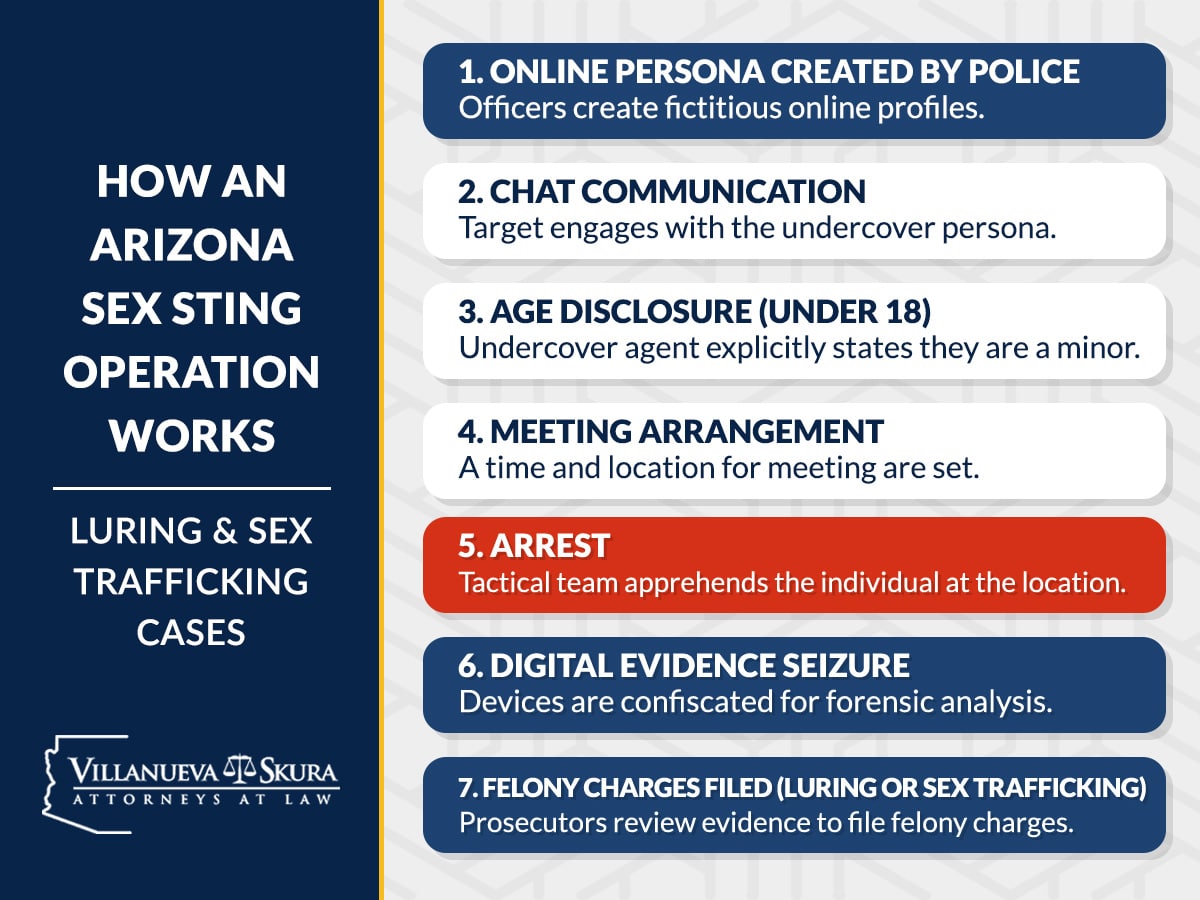
Individuals arrested in Phoenix and surrounding communities often encounter similar investigative tactics during an online sex sting. Having reviewed hundreds of sting case files, we consistently observe the same investigative patterns used by agencies participating in the HEAT Unit and other task forces across the state.
Detectives pose as minors on platforms such as Snapchat, Kik, Instagram, Discord, and various dating or messaging applications. As we discuss in our article on how law enforcement takes advantage of escalation of commitment, these profiles are often designed to build rapport and emotional investment before the fictitious persona ever discloses an age under eighteen.
The fictitious persona typically discloses being under 18 early in the conversation. This is a strategic investigative step intended to establish knowledge and intent evidence for prosecution. This early disclosure is later used by prosecutors to argue that the accused was aware of the stated age and continued the communication despite believing they were interacting with a minor.
Officers may encourage a meeting at a public location such as a park, shopping center, or hotel or motel parking lot, followed by an immediate arrest upon arrival. In some cases, even if the accused changes direction or never arrives, law enforcement may still effect the arrest using air surveillance.
Phones, computers, and online accounts are frequently seized and forensically analyzed to build a case centered on chat logs, metadata, and digital activity. These seizures routinely extend far beyond the sting conversation itself, which is why the next section is one of the most important parts of this article.
Many of our clients are surprised to learn that the sex sting arrest itself may only be the starting point of their legal exposure. In many Arizona sex sting investigations, law enforcement will obtain search warrants for cell phones, computers, tablets, external drives, cloud accounts, and other digital storage devices.
While the stated purpose of the warrant is often to locate communications related to the sting investigation, the forensic examination typically extends far beyond chat messages alone. Digital forensic analysts commonly review the entire contents of seized electronics, including stored images, videos, deleted data, internet search history, browser cache, downloads, application data, social media archives, and cloud backups.
From a defense perspective, one of the most serious risks arises when investigators begin examining devices for alleged child sexual abuse material (CSAM), often charged under Arizona law as Sexual Exploitation of a Minor pursuant to A.R.S. § 13-3553.
In our practice, we have represented clients who were originally arrested on sting-related luring charges and subsequently faced additional felony counts for Sexual Exploitation of a Minor after investigators located images or cached content on their devices during the forensic examination. In several of these cases, the CSAM charges carried significantly harsher sentencing exposure than the original sting charges. What began as a luring investigation became a multi-count Sexual Exploitation prosecution with potential DCAC sentencing.
This is not a rare occurrence. Forensic analysts routinely flag any images, cached thumbnails, or downloads that they interpret as illegal content. Prosecutors may then file additional charges separate from the original sting allegations, and these charges can include multiple felony counts based on the number of images located during the forensic examination rather than a single count tied to a device.
The expanded investigation is one of the primary reasons why hiring a defense attorney immediately after a sting arrest is critical. Early intervention allows counsel to evaluate warrant scope issues, challenge forensic methodology, and prepare for the possibility that additional charges may follow.
Although Arizona law permits charges without the involvement of a real minor, these cases are not automatic convictions. They often involve complex digital evidence, intent analysis, and constitutional issues that require a highly specialized defense approach.
Arizona law defines entrapment as law enforcement inducing a person to commit a crime they otherwise would not have committed. However, many sting operations are deliberately structured to present an opportunity rather than inducement, which makes the legal threshold for entrapment very difficult to meet under Arizona law. That said, every case is different. We closely analyze the full timeline of communications to determine whether escalation of commitment tactics or aggressive investigative behavior crossed the line from opportunity into inducement.
Sex sting investigations frequently involve extensive search warrants for electronic devices and online accounts. Defense analysis often focuses on warrant scope, forensic methodology, and constitutional protections. In our cases, we work with experienced digital forensic experts who analyze chat extractions, device data, metadata, and forensic artifacts to identify inconsistencies, investigative errors, or alternative explanations related to the electronic evidence.
This expert-driven forensic review is especially critical in cases involving seized electronics and CSAM allegations, where the difference between a cached thumbnail and an intentionally saved file can determine whether a client faces additional felony counts.
When defending allegations involving luring, aggravated luring, or sex trafficking of a minor, a comprehensive and technically sophisticated defense strategy is essential. Our legal team at VS Criminal Defense Attorneys conducts a full contextual analysis of the communications rather than relying on selective excerpts presented by investigators.
We work with a dedicated network of experts including digital forensic analysts, psychosexual evaluators, and investigators who help us build a defense that addresses the technical, legal, and human dimensions of each case. This level of expert collaboration is critical because sex sting prosecutions rely heavily on the state’s interpretation of digital evidence, and that interpretation must be challenged at every level.
Allegations involving Luring of a Minor, Aggravated Luring, Sexual Exploitation of a Minor, and Sex Trafficking of a Minor carry some of the harshest penalties under Arizona law, including lengthy prison sentences, lifetime sex offender registration, and permanent reputational harm.
If you are under investigation or have been arrested in connection with a sex sting in Phoenix, the East Valley, the West Valley, Maricopa County, or Pinal County, you should not speak to law enforcement without legal counsel. As we discuss in our article on the top mistakes people make during a sex crime investigation, investigators in these cases are focused on building prosecutable evidence, not resolving misunderstandings or proving your innocence. Early legal intervention from a firm focused exclusively on sex crime defense can significantly impact how the case is investigated and charged.
Contact VS Criminal Defense Attorneys today for a confidential consultation at (480) 923-9001 or visit us at www.vsattorney.com.
Can I be charged with a sex crime in Arizona if there was no actual child involved?
Yes. Under statutes such as A.R.S. § 13-3554 and A.R.S. § 13-3560, it is not a defense that the other person was actually an undercover officer or a fictitious persona. Arizona law focuses on the defendant’s belief and intent during the communication, not on whether a real minor existed. Felony charges including luring, aggravated luring, and sex trafficking of a minor can all be filed in cases where the “minor” was entirely fictitious.
What is DCAC and how does it apply to sex sting cases?
DCAC stands for Dangerous Crimes Against Children under A.R.S. § 13-705. When the fictitious persona in a sting operation is represented as being under fifteen years old, DCAC sentencing may apply. This means significantly harsher mandatory prison ranges and, in most cases, no eligibility for probation. Because many sting personas are deliberately set at ages like thirteen or fourteen, DCAC exposure is common in these investigations.
Can I face additional charges if my phone or computer is seized after a sting arrest?
Yes. Law enforcement routinely obtains search warrants for electronic devices following a sting arrest. During the forensic examination, investigators review the entire contents of seized devices. If any images, cached thumbnails, or downloads are interpreted as child sexual abuse material (CSAM), prosecutors may file additional Sexual Exploitation of a Minor charges under A.R.S. § 13-3553. These charges are separate from the original sting allegations and can carry significantly harsher sentencing exposure, particularly under DCAC.
What is entrapment and can it be used as a defense in a sex sting case?
Under A.R.S. § 13-206, entrapment occurs when law enforcement induces a person to commit a crime they otherwise would not have committed. However, Arizona sting operations are deliberately structured to present an opportunity rather than inducement, making the legal threshold for entrapment very difficult to meet. An experienced defense attorney will closely analyze the full communication timeline to evaluate whether investigative tactics crossed the line from opportunity into inducement.
What are the potential penalties for a sex sting conviction in Arizona?
Penalties vary depending on the charges filed. Aggravated Luring of a Minor is a Class 2 Felony with significant prison exposure. Sex Trafficking of a Minor can carry mandatory life imprisonment without parole if convicted at trial. When DCAC sentencing applies, mandatory prison ranges increase further and probation is generally unavailable. In addition to incarceration, a conviction may result in lifetime sex offender registration, loss of professional licenses, and permanent reputational harm.
Should I talk to the police after being arrested in a sex sting?
No. You should invoke your right to remain silent and your right to counsel immediately. Statements made to law enforcement after a sting arrest are used to strengthen the prosecution’s case, not to help the accused. Say: “I am exercising my right to remain silent and my right to counsel. Please contact my attorney.” Then contact a sex crime defense attorney immediately.
When should I hire a lawyer if I have been arrested in a sex sting?
Immediately. The period following a sting arrest is critical because law enforcement may be executing search warrants on your devices, building additional charges, and preparing their case while you wait. Early legal intervention allows your attorney to evaluate warrant scope, preserve defense evidence, and begin building a defense strategy before the prosecution’s narrative solidifies.
Michelle Skura, Esq. is the lead attorney and owner of VS Criminal Defense Attorneys. With an exclusive focus on felony sex crimes and major felony defense in Arizona, she is a passionate advocate for individual rights and constitutional accountability. Recognized as a Top 100 Criminal Defense Attorney by the National Trial Lawyers, she provides aggressive and strategic representation to ensure that every client’s voice is heard and their rights are protected.
Legal Disclaimer: This content is provided for informational and educational purposes only and is not legal advice. Reading this content does not create an attorney-client relationship with VS Criminal Defense Attorneys or Michelle Skura, Esq. Every case is fact-specific, and individuals facing allegations related to an Arizona sex sting, luring of a minor, or sex trafficking of a minor should consult a qualified Arizona criminal defense attorney with a focus on sex crimes regarding their specific situation.